Home / Technology

Parallel ship-loading technology

A separate technological flow — from the truck to the hold — that works alongside the port’s main line without taking it over.
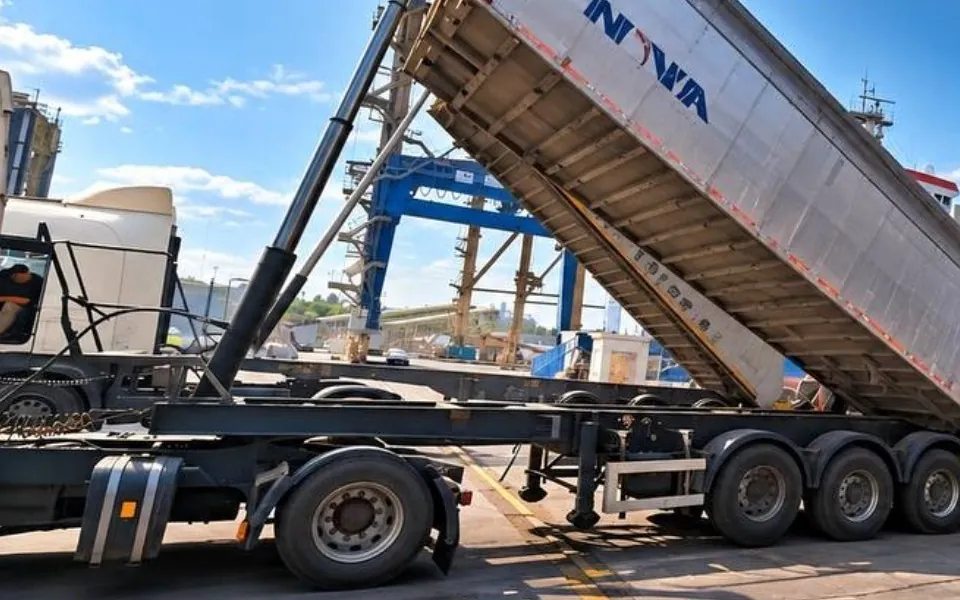
Grain truck unloading directly into the hopper of a mobile ship-loading machine
Direct unloading from the truck into the hopper of the ship-loading machine.
How the additional flow is created

From truck to hold

The line receives cargo from road transport and delivers it straight into the vessel.

  1. 1
    Receiving cargo from road transportTrucks unload directly into the hopper of the ship-loading machine.
  2. 2
    Feeding via a mobile hopper and conveyorA separate line that does not depend on the port’s main equipment.
  3. 3
    Loading and distributing cargo in the holdA controlled feed point fills the hold evenly, including corners.
  • Fast and continuous unloading
  • Minimal cargo losses
  • Works with different types of grain trucks
  • Integrates into the port’s existing infrastructure
  • Suitable for Handysize vessels up to 35,000 tonnes
We own the technology, not just the equipment

In-house engineering

We design, manufacture and operate the equipment ourselves.

01

Design for real port tasks

Equipment is built around the way terminals actually work.

02

Adaptation to a specific berth and cargo

Each setup is configured for the berth and the cargo it will handle.

03

Our own engineering solutions

Developed by our team, not taken from a standard catalogue.

04

Continuous refinement

The equipment is improved based on operating experience.
The port doesn’t adapt to a standard machine — the solution adapts to the port.
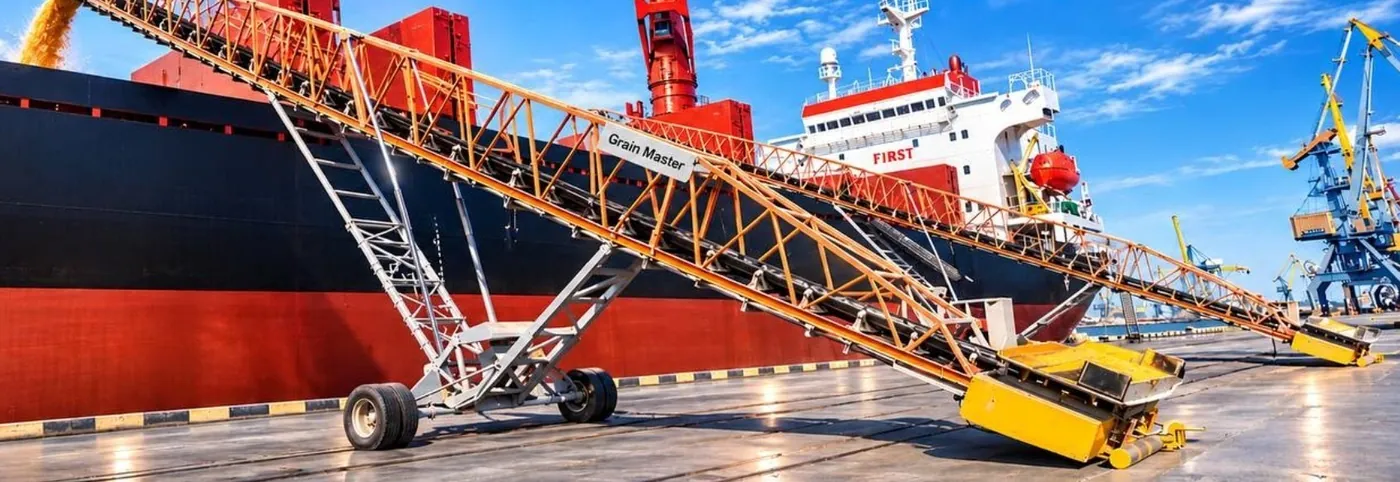
Ship-loading conveyor feeding cargo into the hold of a bulk carrier
Loading quality is part of the result

Control in the hold

It matters not only to move the cargo, but to control the feed point and how the material is distributed.

  1. 1
    Rotation to the right and leftA rotating telescopic spout moves the feed point across the hold.
  2. 2
    Adjustable feed heightThe feed point is raised and lowered as the hold fills.
  3. 3
    Filling the corners and zones of the holdCargo reaches hard-to-access areas, not only the centre.
  4. 4
    Levelling the layerAn even cargo profile along the length of the hold.
  5. 5
    Remote controlAll movements are operated remotely.

A stable, controlled and accurate loading operation.

Technology gives the operator control

Operation control

Remote control allows more precise positioning of the feed and monitoring of the equipment’s operation.

01

Spout positioning

Precise placement of the feed point in the hold.

02

Raising and lowering the feed point

Feed height follows the level of the cargo.

03

Distribution across hold zones

Material is spread where it is needed.

04

Less need to be in the discharge area

The operator works from a safer position.

A more manageable technological process for the terminal.
Equipment throughput and scaling potential

500–600 tonnes per hour

Current working throughput of the equipment with a stable cargo supply.

Scaling is achieved by adding feeders and extending the technological line, provided the cargo supply is stable and sufficient.

Feeder 1stable feed
Feeder 2added when the scheme is confirmed
Conveyor to the vesselloading & distribution in the hold
500–600 t/h1,000–1,200 t/h
Next step

Let’s find where we can strengthen your terminal.

We choose one berth and one real cargo flow. Then we prepare a project-specific technological scheme for your technical team.

Message us on WhatsApp [email protected] WhatsApp: +44 7715 515022  ·  Email: [email protected]